
Solar Panel Grants 2026: What UK Homeowners Can Still Claim (And How to Apply)
An up-to-date guide for homeowners in West London and London, as at 20 November 2026.
For homeowners considering solar panels, the funding picture is more nuanced than some advertisements suggest. A genuine grant is available in England, but it is means-tested and has strict property criteria. Other options can help with the cost, but a loan is not a grant, export payments are income rather than funding, and council-backed buying schemes do not provide public money towards your installation.
That distinction matters in Chiswick, Hammersmith, Hampton, Kingston and Richmond, where many homes have distinctive roofs, mature garden trees or heritage protections. The right approach is to check eligibility first, understand the alternatives, then specify a system that suits the property.
The main grant: Warm Homes: Local Grant
The Warm Homes: Local Grant is the principal current grant route for eligible privately owned homes in England. Councils deliver it using funding under the Warm Homes Plan. The programme runs from 1 April 2025 to 31 March 2028, subject to local funding and availability.
To qualify, the home must:
- Be in England and privately owned, either by an owner-occupier or a private landlord.
- Have an Energy Performance Certificate (EPC) rating of D, E, F or G.
- Meet at least one household eligibility route: gross household income is usually £36,000 or less; someone in the household receives a listed means-tested benefit; or the home is in a qualifying postcode area among the most deprived deciles.
A property with an EPC rating of C or better does not qualify. Nor does meeting the income or postcode test alone override the EPC requirement.
Solar PV is an eligible measure. A battery may also be funded, but only alongside solar panels. The published cost caps are £16,600 per home for energy performance measures and £16,600 for low-carbon heating measures. These are scheme caps, not a promise that every eligible household will receive the full amounts or be offered every measure.
Apply using the government’s online eligibility checker. If you appear eligible, it passes your details to the relevant council. The council usually makes contact within about 10 working days to request further information and arrange a home survey. For help applying, call the scheme’s assisted digital support helpline on 0800 098 7950.
Government statistics up to the end of July 2026 reported solar PV in 38% of installations and batteries in 18%, across around 5,470 households. That demonstrates solar is part of the scheme, but it does not make the grant universal.
The candid reality for West London: many affluent households will not meet the income test, and a C-rated home is excluded regardless of household income. If you live in a well-maintained period property in Richmond or Chiswick, check the criteria, but do not plan a project around a grant until your council confirms eligibility and funding.
A loan, not a grant: Warm Homes Loan Scheme
The Warm Homes Loan Scheme is a different option. Launched in late October 2026, it provides subsidised finance through participating lenders. It is not a grant and you must repay what you borrow.
Owner-occupiers and private landlords across the UK may apply; tenants cannot borrow. The government’s eligibility page does not set an income test, but each lender carries out its own credit and affordability checks. The scheme offers up to £15,000 for solar PV and up to £15,000 for battery storage.
The government pays the lender up to 20% of the loan, allowing the interest rate to be reduced by up to five percentage points, but not below zero. A loan must run for at least three years to receive the rate reduction. The government’s worked example says a £10,000 loan at 8% over seven years could save up to £285 a year in repayments through the scheme. Your actual terms and savings will depend on the lender and offer.
Installations must be completed by an MCS-certified installer. You cannot use the loan alongside other government funding for the same improvement, and some loans may be secured against your home. Read the lender’s terms carefully, including the total amount repayable and what happens if you sell or remortgage.
0% VAT: a valuable saving with a firm deadline
The installation of solar panels and eligible battery storage in residential accommodation currently attracts 0% VAT until 31 March 2027. From 1 April 2027, the rate is due to return to 5%, as set out in HMRC’s VAT guidance.
You do not apply for this relief. The installer should charge the correct rate on the qualifying installation. For a £7,000 installation, 5% VAT would add £350, so the current zero rate represents a meaningful saving. It is a reason to get informed quotes and plan ahead, not to rush into a poorly assessed design as the deadline approaches.
Smart Export Guarantee: income for electricity you send back
The Smart Export Guarantee (SEG) is not a grant. It is a route to payment for eligible electricity exported to the grid. Under the Ofgem framework, larger licensed suppliers must offer an export tariff that pays more than zero for exported electricity, but suppliers set their own rates and terms. Compare current offers using Ofgem’s SEG guidance.
You generally need an MCS certificate and a meter that records exports; many smart meters can do this, but check with your supplier. On 18 November 2026, Octopus listed Outgoing Octopus at a flat 12p per kWh and Prime Outgoing at 16p per kWh from 4pm to 7pm and 9p at other times. Tariffs can change, so treat these as a dated example rather than a guaranteed return. Export income from a domestic microgeneration system at a home you occupy is exempt from Income Tax.
A well-sized battery may let you use more of your own solar generation during the evening, while exporting surplus at other times. The best balance depends on your household’s usage, tariff and the battery’s installed cost.
Switch Together: group buying, not public funding
Switch Together, formerly Solar Together, is a council-backed group-buying scheme. Homeowners register their interest, vetted installers bid in a reverse auction, and participants can accept or decline the price offered. It does not provide a grant.
Rounds open and close by area, and the scheme is not currently running across every West London borough. If interested, check with your council and register interest, but do not delay a project on the assumption that a local round will open.
What a properly specified system looks like in a period home
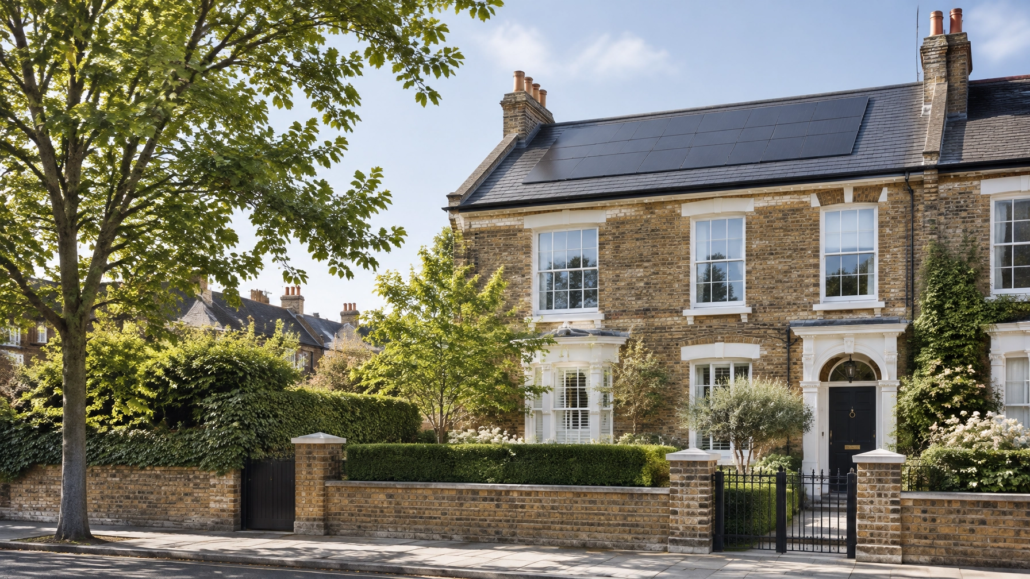
In a home in Hampton, Kingston or Hammersmith, an attractive solar installation begins with the building itself. A desktop panel count is not a design. The survey should consider roof orientation, usable roof area and shade from chimneys and mature trees, which can be significant in leafy streets and walled gardens.
Slate and clay tiles need appropriate mounting methods and careful detailing to protect the roof. Ask how the proposed system will be fixed, how penetrations will be weather-sealed, and whether panels can sit discreetly within the roofline. The cable route should be planned to minimise visual impact while remaining accessible for future maintenance.
The installer should also assess consumer unit capacity and the electrical supply before finalising the design. Battery capacity should reflect when you use electricity, particularly your evening demand, rather than simply being matched to the panel count. If an EV charger may be added later, discuss its likely location, cable route and electrical requirements now, so future work can be coordinated sensibly.

Installation standards, planning and property protection
MCS certification is a common thread through the Local Grant, the Warm Homes Loan Scheme and SEG eligibility. Ask the installer to confirm its MCS number and check it independently. Without the required certification, you may lose access to funding or export payments.
Electrical work must comply with BS 7671:2018+A4:2026, the current wiring regulations. Since 15 October 2026, this is the only acceptable edition. Ask for the electrical installation certificate and the relevant notification under Part P.
Planning rules also changed in 2026. The Town and Country Planning (General Permitted Development) (England) (Amendment) Order 2026 came into force on 27 August. Roof-mounted domestic solar is generally permitted development, but that is not a blanket assurance for every property. Listed buildings, conservation areas, flat roofs and stand-alone arrays in gardens can bring additional restrictions or prior-approval requirements. In parts of Chiswick, Hammersmith and Richmond, the property’s designation and exact location may change the answer. Check with the local planning authority before ordering equipment.

The Future Homes and Buildings Standards take effect in March 2027. They do not require existing homeowners to retrofit their properties, but they raise expectations for the energy performance of new homes. For existing homes, a well-considered energy upgrade may be relevant to future buyer expectations and a property’s appeal, though it is not a guarantee of a particular valuation.
What about ECO4 and the Great British Insulation Scheme?
ECO4 ends on 31 December 2026, with no successor supplier obligation planned. Because the scheme is close to its end date, new applications may not be completed in time. If an installer or supplier says an ECO4-funded solar project can proceed, get the expected completion date in writing before committing.
The Great British Insulation Scheme closed on 31 March 2026. Neither scheme should be presented as an open-ended source of new funding.
Beware of misleading solar offers
A few claims deserve particular scrutiny:
- There is no government grant called the “UK Solar Programme” and no standalone “postcode lottery” grant. A qualifying postcode can be one route into the Warm Homes: Local Grant, but the scheme has other criteria, including the required EPC band.
- The Feed-in Tariff closed to new applicants on 1 April 2019. New systems may earn through the SEG instead.
- The Green Homes Grant closed to applications on 31 March 2021.
- “Rent-a-roof” is a lease on your roof, not a grant. It can complicate a future sale, so understand the contract and its impact on the property before signing.
- HMRC does not fine homeowners for having solar panels.
- A legitimate scheme does not require you to sign on the doorstep. Take time to check the offer and obtain another quote.
A quality proposal should set out the equipment, expected generation assumptions, battery specification, roof and electrical work, certification, warranties, VAT treatment and any planning considerations. It should also explain, in plain terms, which funding route it assumes and what happens to the figures if that assumption proves wrong.
For a considered discussion about solar PV, battery storage or a wider home improvement project in West London, contact Evolve Renovations & Developments Ltd.