
Electric Car, No Driveway? How to Get an EV Charger Installed at Home
For many homeowners on West London’s Victorian and Edwardian streets, the missing driveway has seemed like a hard stop on home EV charging. That changed on 21 October 2026: eligible cross-pavement cable channels in England can now benefit from permitted development rights, removing the planning-permission hurdle in qualifying cases. The Government says this change could save drivers up to £300 in planning costs; it does not mean every site is automatically suitable or authorised.
For homeowners in Chiswick, Hammersmith, Hampton, Kingston, Richmond and Hounslow, the important distinction is this: planning permission and highway-authority approval are separate matters. A safe, compliant installation still depends on the pavement, the property’s electrical supply and the local authority’s requirements.
How cross-pavement home charging works
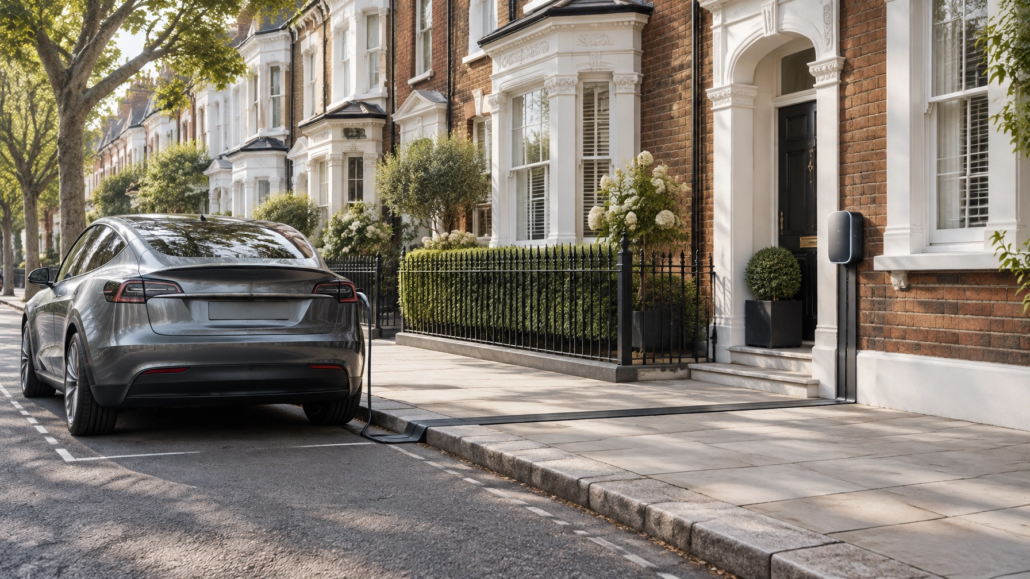
A cross-pavement solution uses a purpose-designed channel embedded flush in the pavement. When you charge, your cable sits in the channel to cross the footway between the charge point at your home and your vehicle parked at the kerb. The cable is removed when charging is complete.
The channel is intended to avoid leaving a loose cable across the walking surface. It is not permission to trail a lead over the pavement, nor does it reserve the parking space outside your home. The highway authority will consider pedestrian safety, accessibility, the position of utilities and trees, pavement construction, parking conditions and the proposed channel’s design and maintenance.
The new right is set out in Class F of the 2026 amendment to the permitted development rules. It applies to a cross-pavement solution installed by, on behalf of, or with the authorisation of a highway authority. Once the channel is no longer needed, it must be removed as soon as reasonably practicable and the pavement reinstated.

Permissions, eligibility and the 1.5-metre point
Permitted development removes a planning application for a qualifying channel; it does not give a householder an automatic right to alter the public highway. You will still need to establish the process with the relevant highway authority. Under Section 178 of the Highways Act 1980, consent is required for certain apparatus placed over, along or across a highway, and the authority can set conditions. Depending on the installation method and local process, additional street-works permissions or licences may also apply.
There are important heritage exclusions. Class F permitted development does not apply where the channel would be within a conservation area, the curtilage of a listed building or a scheduled monument site. If your home or proposed route falls into one of these categories, seek advice from the relevant planning and highway authorities before proceeding; other consents may be required.
The 1.5-metre footway measurement is relevant to certain permitted-development conditions for a wall-mounted charge point adjoining a highway. It is not a blanket minimum width for every pavement channel. Depending on the outlet’s position and how far it projects from the wall, the applicable conditions need to be checked for the property. Narrow pavements, street furniture and the accessibility of the route are also practical matters for the highway authority to assess.
The Government’s cross-pavement guidance sets out the wider safety, permissions and maintenance considerations. Its principles are particularly relevant on West London’s varied terraces, where pavement widths, front elevations and on-street parking can change from one property to the next.
What a home and electrical survey should establish
Before choosing equipment or agreeing a route, arrange a site survey. The installer should check the existing consumer unit and supply to establish whether the installation can support a dedicated EV circuit, what protective measures are needed and whether the home’s electrical capacity or supply arrangements require attention.
In a terraced house, the consumer unit may be in a rear hallway, under the stairs or elsewhere well away from the front elevation. The cable route might run through floors, ceilings, cupboards or other parts of the property. A longer route can affect the amount of cabling, the installation work, voltage drop and the final finish. A survey helps identify a safe, practical route and discuss any making-good required.
The assessment should also consider the intended parking position and cable reach, the charge point’s location, potential obstructions and whether the proposed channel can be installed without damaging utilities, roots or the pavement. A cross-pavement scheme may be unsuitable if regular parking adjacent to the property is unlikely or if local site conditions cannot be accommodated.

Electrical safety: the current wiring standard
New electrical installation work must comply with BS 7671:2018+A4:2026. From 15 October 2026, this is the only acceptable edition for new work; the transition period for the previous edition has ended. The IET’s guidance on cable channels embedded in pavements explains why an installation requires more than simply fitting a charger and routing a cable.
A key design consideration is the risk of simultaneous contact with conductive parts connected to different earthing systems, for example, a vehicle while charging and some electrically supplied street furniture. The installer needs to assess the realistic position and extent of the vehicle, alongside nearby infrastructure. Where a different earthing arrangement could be simultaneously accessible, guidance generally recommends around 2.5 metres’ separation. This is not a rule that every piece of metal street furniture must be exactly that far away: the type of equipment and its electrical and earthing arrangements matter. Streetlights and illuminated signs, in particular, may need careful consideration, and the distribution network operator or asset owner may need to help establish how they are supplied.
The assessment must be recorded and addressed in the electrical design. An open-PEN protection device, where required, does not by itself resolve every risk involving different earthing systems.
A typical process, from survey to certification
Each authority has its own process, but a well-managed project will generally follow these steps:
- Initial discussion and site review: Confirm the property, likely parking pattern, pavement conditions and which highway authority manages the street.
- Electrical and route survey: Check the consumer unit, supply, proposed dedicated circuit, charge-point position and cable route through the home.
- Highway-authority application: Submit the information requested for the cross-pavement solution and obtain the relevant written consent or authorisation. Confirm responsibilities for installation, maintenance, liability and eventual removal.
- Electrical design and installation: Agree the specification, complete the necessary electrical work and arrange the authorised channel installation in line with the agreed method.
- Testing and handover: Test and certify the electrical installation, provide the relevant documentation and explain safe use and upkeep, including removing the lead after charging and keeping the channel clear.
Evolve Renovations & Developments provides renewables services, including EV charger installation, alongside electrical works. Coordinating the survey, electrical work and installation planning helps homeowners understand what is involved before work begins.
What to expect from the cost
The total cost depends on the property and route, the charger and electrical work required, the chosen channel system, and the highway authority’s process and conditions. A long cable route through a terraced home, changes to the existing electrical supply or additional highway requirements can all affect the scope.
The planning change may remove one cost for eligible proposals. The Government estimates savings of up to £300, but it does not remove the costs of the charger, electrical installation, channel, highway authorisation or ongoing responsibilities. Ask for a clear proposal that separates these elements and explains who maintains the channel. For the right home, the value is the possibility of convenient charging from the domestic supply without converting a front garden or relying solely on public charge points.
A practical option for West London terraces
A home without a driveway is no longer automatically ruled out from home charging. For many terraced homes in Chiswick, Hammersmith, Hampton, Kingston, Richmond and Hounslow, an authorised pavement-embedded channel may offer a considered alternative. Provided the property, pavement, local permissions and electrical design are suitable.
The route to a reliable result begins with a proper survey and clear coordination between the homeowner, installer and highway authority. To discuss your property and the next steps, contact Evolve Renovations & Developments.